
A Master Saddler’s Buying Guide
Buying a saddle—whether new or second-hand—is one of the most significant investments you’ll make for your riding and your horse’s long-term soundness. Across Europe, from Warmbloods jumping in Germany to compact cobs hacking out in the UK or Iberian horses working in Spain, a poor saddle fit causes real damage: muscle atrophy, behavioral resistance, and a compromised seat for the rider.
At Euro Saddle Shop, every saddle in our workshop hub in the Netherlands goes through a rigorous 24-point bench inspection before it ever leaves our doors. But beyond measurements on paper, choosing the right saddle comes down to understanding how tree architecture, panel design, and rider biomechanics intersect.
Here is our master saddler guide to navigating seat shapes, tree profiles, panel choices, and leather options so you can find the ideal match for your team.
Step 1: Clarify Your Discipline & Balance Point
Before you look at brand names, think about where your seat needs to sit. Every discipline relies on a distinct balance point (or sweet spot):
-
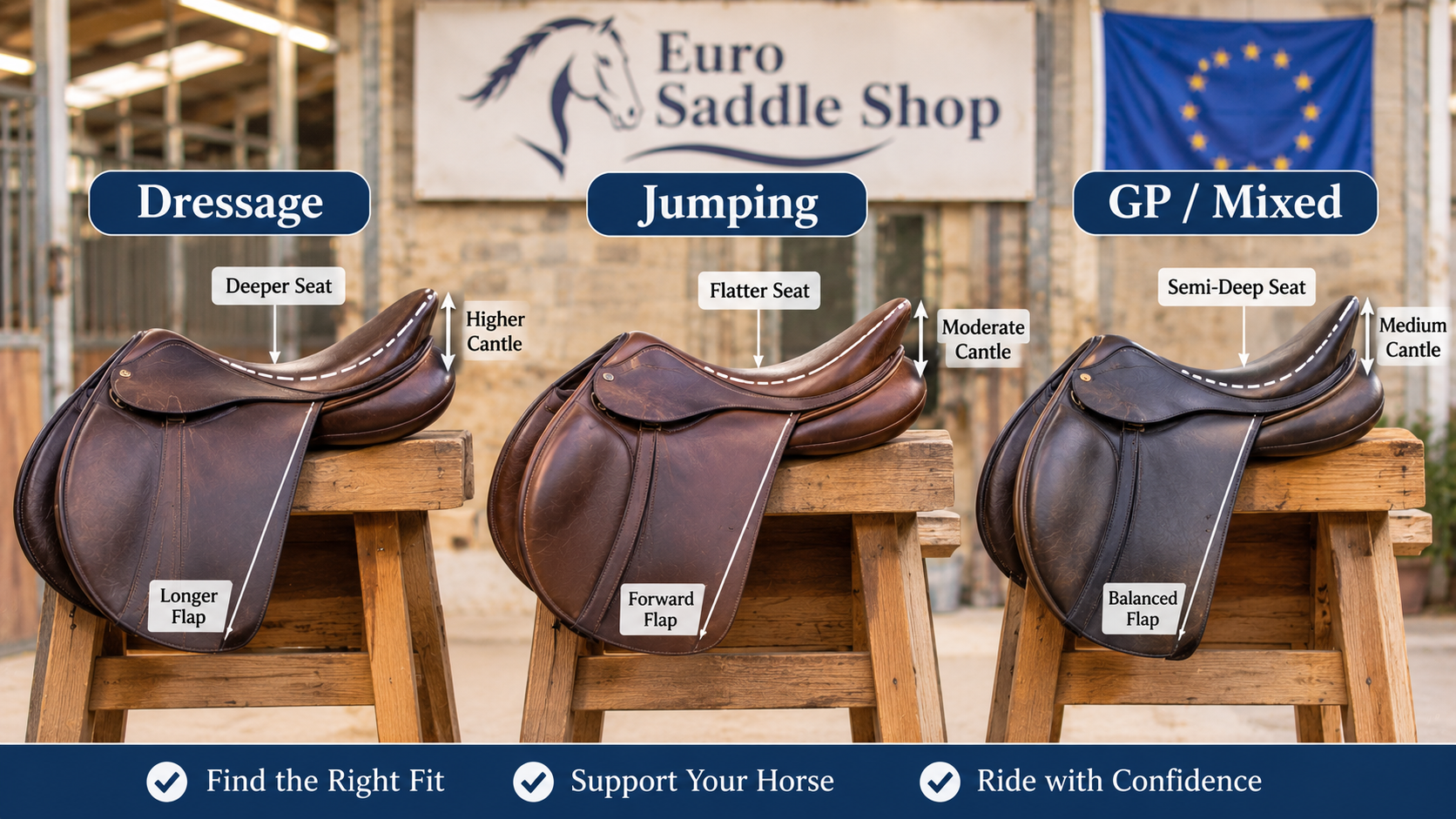
Dressage Saddles: Feature a deeper seat, a narrow twist, and long, straight flaps designed to drop your leg into a long, relaxed position. Look for anatomical thigh blocks that support your alignment without pinning your knees or blocking your hip rotation.
-
Show Jumping & Close-Contact Saddles: Built with a flatter or semi-deep seat, forward-pitched flaps, and a balance point that keeps you centered over your feet when your stirrups are short. This allows you to stay balanced over fences without your knees overshooting the front roll.
-
General Purpose (GP) / Eventing Saddles: A practical middle ground with a semi-deep seat and moderate flap angle. Ideal if you split your time between flatwork, small fences, and hacking out in the countryside.
Step 2: Match the Tree Shape to Your Horse’s Topline
The tree is the rigid frame of your saddle. If the tree profile doesn’t match your horse’s natural back shape, no amount of padding or flocking will fix the pressure points.
Wither Clearance + Shoulder Angle + Spinal Channel Width = Free Locomotion
1. High Withers & Hollow Shoulders (Garrot Saillant)
-
Common in: Thoroughbreds, modern Warmbloods, and older horses.
-
What to look for: A deep pommel arch, generous tree sockets, and specialized Drop-Panels (K-Panels) that fill the hollows behind the scapula without pinching the withers laterally.
2. Flat, Broad Backs (Dos Plat)
-
Common in: Cobs, Friesians, Haflingers, and Iberian breeds.
-
What to look for: An open U-Shaped Tree (Hoop Tree) rather than a narrow V-tree. Pair this with a wide gullet channel (at least 4 to 5 fingers wide) to keep the saddle from rolling sideways or resting on the spinous processes.
3. Short Backs & Compact Builds
-
Common in: Arabians, PREs, Lusitanos, and compact UK cobs.
-
What to look for: Upswept rear panels that curve upward at the cantle rather than extending flat along the lumbar region. This keeps the saddle footprint strictly forward of the 18th thoracic vertebra (T18).
Step 3: Wool vs. Foam Panels—Which Fits Your Routine?
The panels cushion the tree against your horse’s long back muscles (longissimus dorsi). Both materials have clear strengths depending on how you manage your tack:
| Feature | Wool-Flocked Panels | High-Density Foam Panels |
| Adjustability | Easy to tweak, repack, or balance as your horse changes shape or muscle mass. | Fixed shape; requires shim pads or tree adjustments to alter the fit. |
| Feel | Soft, moldable, and forgiving over minor muscle asymmetry. | Close-contact feel with consistent, lightweight impact protection. |
| Maintenance | Needs routine top-up flocking every 12–18 months. | Virtually zero maintenance; won’t pack down, shift, or lump over time. |
| Popular Brands | Passier, Albion, Kent & Masters, Thorowgood | Devoucoux, CWD, Équipe, Voltaire Design |
Step 4: Fit the Saddle to Your Biomechanics
A saddle can fit your horse perfectly, but if it forces you off-balance, your body weight will create focal pressure points on your horse’s back.
-
Seat Size: You should have roughly 4 finger-widths of space between your seat and the rear cantle. If the seat is too small, your weight gets pushed back onto the cantle and over the horse’s loins.
-
Twist Width: The twist is the narrowest section of the seat between your thighs.
-
Narrow Twist: Best for riders with narrower hips or those who prefer a close-contact, dropped-thigh feeling.
-
Wide Twist: Offers a broader base of support and more surface area, preferred by riders who like a solid, supportive seat.
-
-
Flap Length & Angle: At your normal stirrup length, your knee should sit comfortably in the pocket of the knee roll without pushing over the front seam.
Step 5: New vs. Pre-Owned English Saddles
Deciding between brand-new leather and a quality second-hand saddle comes down to budget, leather break-in time, and depreciation:
-
The Case for Pre-Owned: Premium European leather (from makers like Devoucoux, Prestige, or Albion) takes time to soften up. Buying a bench-checked used saddle gives you top-tier leatherwork that’s already supple and broken in, at a fraction of original retail, with zero initial depreciation.
-
The Case for New: Complete factory warranties, fully customizable flap lengths or block options, and pristine leather condition from day one.
⚠️ Saddler’s Warning on Private Sales: When buying used saddles privately, hidden tree cracks or twisted bars are common hazards. Every used saddle at Euro Saddle Shop undergoes mechanical flex testing on our workshop bench before we offer it for sale.
Test Fit in Your Own Arena: The Euro Saddle Shop 5-Day Trial
No matter how good the specifications look on paper, the true test happens when you put your foot in the stirrup.
When you select a new or pre-owned saddle from our inventory, we ship it straight from our Netherlands workshop via insured express courier. You get 5 full days to test the saddle in your own barn:
-
Check the Static Fit: Verify wither clearance (3–4 fingers), spinal channel width, and shoulder clearance on a flat, level surface.
-
Ride All Gaits: Test how the saddle sits at the trot and canter. Watch for any popping up at the back, sliding forward onto the shoulders, or restriction in your horse’s shoulder stride.
-
Get Input: Take a lesson, consult your trainer, or have your local independent fitter inspect the setup while it’s on your horse.
💡 Fitter’s Tip for Trial Rides: Always use a clean saddle pad and soft stirrup leather covers (or a pair of socks over your leathers) during your 5-day trial to protect the flaps from scuffs and keep the leather in original condition.
Need Help Finding Your Next Saddle?
If you aren’t sure which tree profile or seat shape suits your horse, our master saddlers are here to review your wither tracings, conformation photos, and riding goals.
-
Email our fitting team:
sales@eurosaddleshop.com -
General inquiries:
sales@eurosaddleshop.com -
Workshop hours: Monday – Friday, 9:00 AM – 6:00 PM (CET)