Which Is the Better Investment? A Master Saddler’s Honest Take
Every time a rider walks into my workshop with a stiff new saddle box under their arm—or a dusty pre-owned find they picked up off the internet—we end up having the exact same conversation.
They ask me, “Did I actually make the right call spending this much money?”
It’s a fair question. Buying a saddle is easily one of the heaviest financial investments you’ll make in your riding career. More importantly, it’s the physical bridge between your body and your horse’s back. Get it wrong, and you’re looking at bruised muscles, behavioural quirks under saddle, and a hefty repair bill. Get it right, and it feels like riding on air for the next decade.
So, when clients ask me whether they should buy brand-new or hunt down a quality pre-owned model, my answer always comes down to one thing: investment value.
Let’s pull back the curtain on how saddles really hold their value, what you’re actually paying for, and how to spend your hard-earned money without regrets.
The Brutal Truth About Saddle Depreciation
Let’s talk numbers first, because nobody likes losing money.
If you’ve ever bought a brand-new car, you know that sickening feeling of driving it off the lot and watching thousands of dollars vanish into thin air. Saddles do the exact same thing.
-
The New Saddle Hit: The moment you buckle a pair of stirrup leathers onto the bars of a brand-new, factory-fresh saddle and take it for its maiden ride, it’s no longer “new.” You’ve instantly knocked 30% to 50% off its resale value. Even if you clean it with saddle soap religiously every single week, that depreciation curve is merciless during the first one to two years.
-
The Pre-Owned Sweet Spot: A quality, well-maintained used saddle has already taken that financial hit for you. Its value has leveled off. If you buy a solid pre-owned European jump or dressage saddle, take care of the leather, and decide to sell it two years down the road because your horse changes shape, you’ll likely get back every single euro you paid for it.
Where Does Your Money Actually Go? (Buying Power)
Here’s where things get really interesting for your budget.
If you walk into a tack shop with €1,800 to €2,500 in your pocket, you can buy a very decent, entry-to-mid-tier brand-new saddle. It’ll have decent leather, standard synthetic tree components, and it’ll get the job done.
Now, take that exact same €1,800 to €2,500 and drop it into the pre-owned market. Suddenly, you’re looking at top-tier French and German craftsmanship—brands like Devoucoux, CWD, Prestige, Albion, or Passier that originally retailed for €4,000 to €6,000+.
You’re getting buttery-full-grain calfskin, hand-stitched billets, master-crafted tree balance, and wool panels that conform like a glove—all for the price of a mid-range factory model. To me, that’s a no-brainer.
Head-to-Head: How They Compare in the Barn
| Investment Factor | Brand-New Saddle | Pre-Owned (Used) Saddle |
| Resale Value | Drops sharply in the first 2 years | Stable; holds its value remarkably well |
| What You Can Afford | Mid-tier materials and standard hardware | Top-tier European luxury leather and precision trees |
| The Break-In Phase | Often stiff; requires weeks of heavy conditioning | Soft, supple, and sticky from day one |
| Flexibility for Young Horses | Painful to sell later if your growing horse changes shape | Easy to swap out without taking a financial beating |
| Factory Backing | 5- to 10-year manufacturer tree warranty | Relies on workshop bench checks and shop guarantees |
| Custom Tailoring | Built specifically to your exact flap/block specs | Limited to whatever specs are currently on the market |
When Buying NEW Is Actually the Smart Move
I’m a pragmatist. While I love a good used bargain, there are specific scenarios where buying brand-new is worth every single penny:
-
You’re Built Differently: If you have exceptionally long femurs that require an extra-forward flap cut, or you need bespoke knee blocks placed in a very specific position that you simply cannot find on the used market, go custom. Don’t compromise your biomechanics.
-
Your Horse is Finished Growing: If you are putting a saddle on a mature, fully developed adult horse whose back profile is locked in and stable, a new custom fit is a wonderful, long-term marriage.
-
You Want That Direct Factory Warranty: Some riders simply sleep better knowing they have a 10-year manufacturer warranty backing up the wooden tree frame.
When Buying PRE-OWNED Is the Ultimate Winner
For about 80% of the riders who walk through my doors, pre-owned is the absolute gold standard. Here’s why:
-
Young Horses Change Constantly: If you’re bringing along a 4-year-old warmblood or an OTTB that’s going to change its topline and shoulder width dramatically over the next 18 months, do not sink a fortune into a new saddle. Buy a bench-checked used saddle that fits him today. When he broadens out next year, you can resell it easily and move up a tree size without crying over lost equity.
-
Instant Comfort: Let’s be honest—breaking in stiff brand-new leather is a chore. A quality pre-owned saddle already has that gorgeous, broken-in feel, soft knee rolls, and an established seat pocket that loves your pelvis from the very first mounting block.
The Master Saddler’s Warning: How Not to Get Burned Buying Used
I see riders get burned on online classifieds all the time. They see a pretty picture of a used saddle, buy it sight unseen, and bring it to my shop only to find out the tree is twisted or the internal webbing is rotting.
If you’re buying pre-owned, never skip these three checks:
-
The Tree Flex Test: Anchor the pommel against your chest and pull the cantle toward you with gentle, firm pressure. The tree should give just a fraction with a springy, resilient resistance. If it creaks loudly, twists sideways like a wet noodle, or folds too easily, walk away—the tree is broken.
-
Feel the Panels: Run your hands up and down the flocking. If it feels like lumpy rocks under the leather, the wool has compressed unevenly over years of neglect and will give your horse a nasty back sore.
-
Check the Billets: Look closely at where the leather billets stitch into the internal webbing under the skirt. Dry rot and cracked stitching here are dangerous structural liabilities over fences.
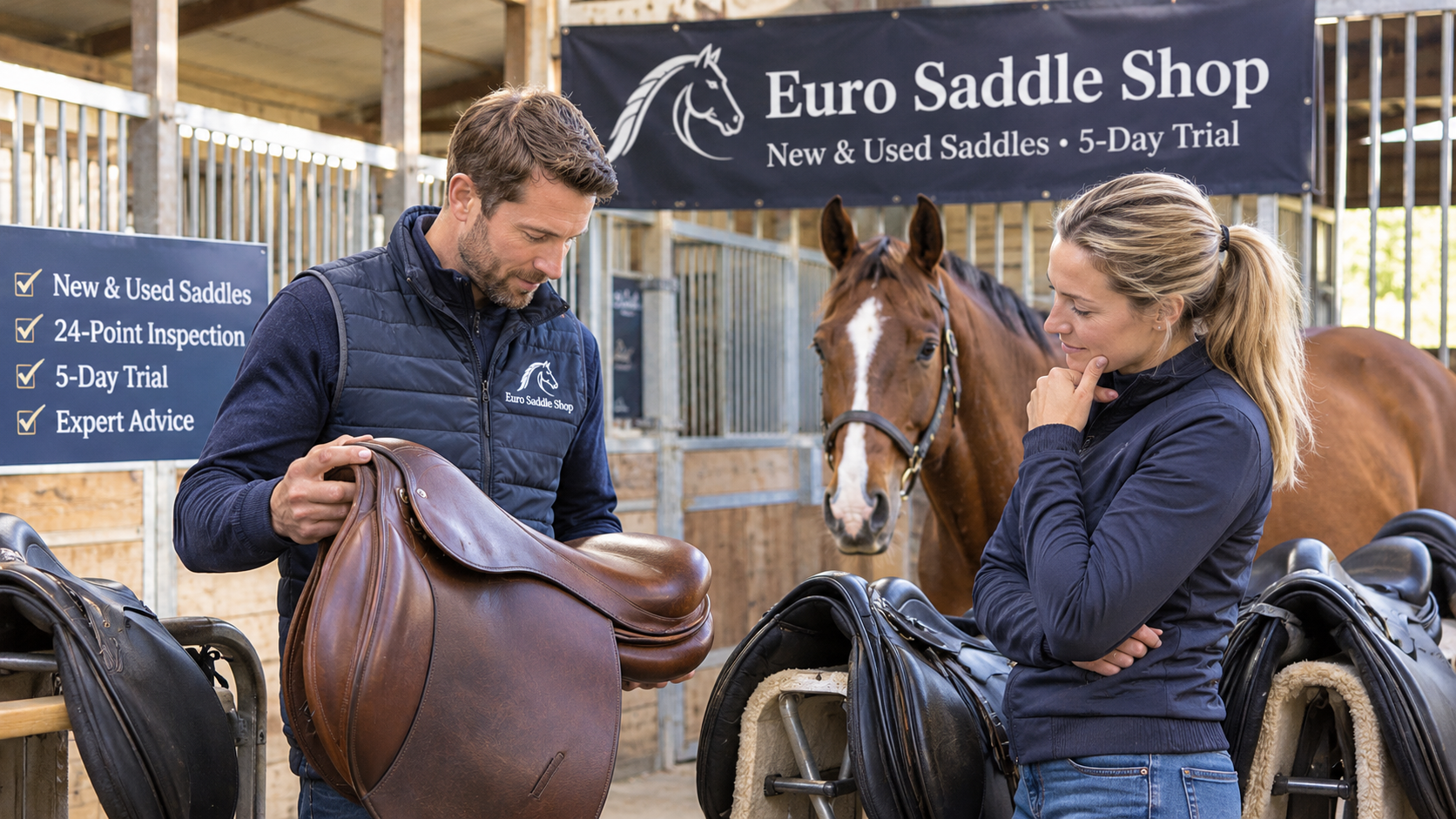
(This, by the way, is exactly why we put every single pre-owned saddle at Euro Saddle Shop through a rigorous 24-point workshop bench inspection before it ever touches our website. You shouldn’t have to guess if a used saddle is safe.)
The Verdict: Which Wins?
If you need highly bespoke factory modifications or custom flap geometries, buying new is your path forward.
But for the vast majority of riders looking to maximize their budget, protect themselves against depreciation, and ride in luxury European leather right out of the gate, a bench-inspected pre-owned saddle is the smartest investment you can make.
Take It for a Test Drive: Our 5-Day In-Barn Trial
Whichever route you choose, a saddle is nothing more than a paperweight until it’s tested on your horse’s back in motion.
That’s why every single saddle we send out from our Netherlands workshop hub comes backed by our 5-day in-barn trial guarantee. Hang it on your horse, ride in your own arena, take a lesson with your trainer, and let your local fitter look it over. If it doesn’t make your horse move like a dream, send it right back.
-
Explore our bench-checked inventory: sales@eurosaddle.eu
-
Talk to our fitting team: sales@eurosaddle.eu