
A Master Saddler’s Guide to Tree Architecture, Fit, and Biomechanics
Whether you are preparing for a dressage test, setting up for a course of fences, or heading out for a five-hour trail ride through the woods, choosing between an English saddle and a Western saddle is one of the most critical decisions you will make for your seat and your horse’s long-term soundness.
While both saddles aim to cushion the rider while protecting the equine spine, their construction, weight distribution, and design philosophies come from two completely different worlds.
At Euro Saddle Shop, every saddle in our inventory—from ultra-close-contact French jump saddles to traditional European stock and trail designs—undergoes a thorough 24-point bench inspection at our workshop hub in the Netherlands before it ever goes out on trial. Here is our breakdown of how English and Western saddles differ, how they alter your horse’s locomotion, and how to make the right choice for your riding.
The Core Difference: Specialized Athletics vs. All-Day Distribution
The structural divergence between English and Western saddles boils down to their historical jobs:
-
English Saddles: Built for close-contact precision, maximum shoulder rotation, and lightweight balance across athletic arenas (dressage, show jumping, eventing, and hunter classes).
-
Western Saddles: Originally built as all-day working platforms for ranch hands, roping, and cattle work. They rely on a massive tree footprint to spread the rider’s weight over a broad area of the ribcage during long hours in the saddle.
Technical Breakdown: English vs. Western Architecture
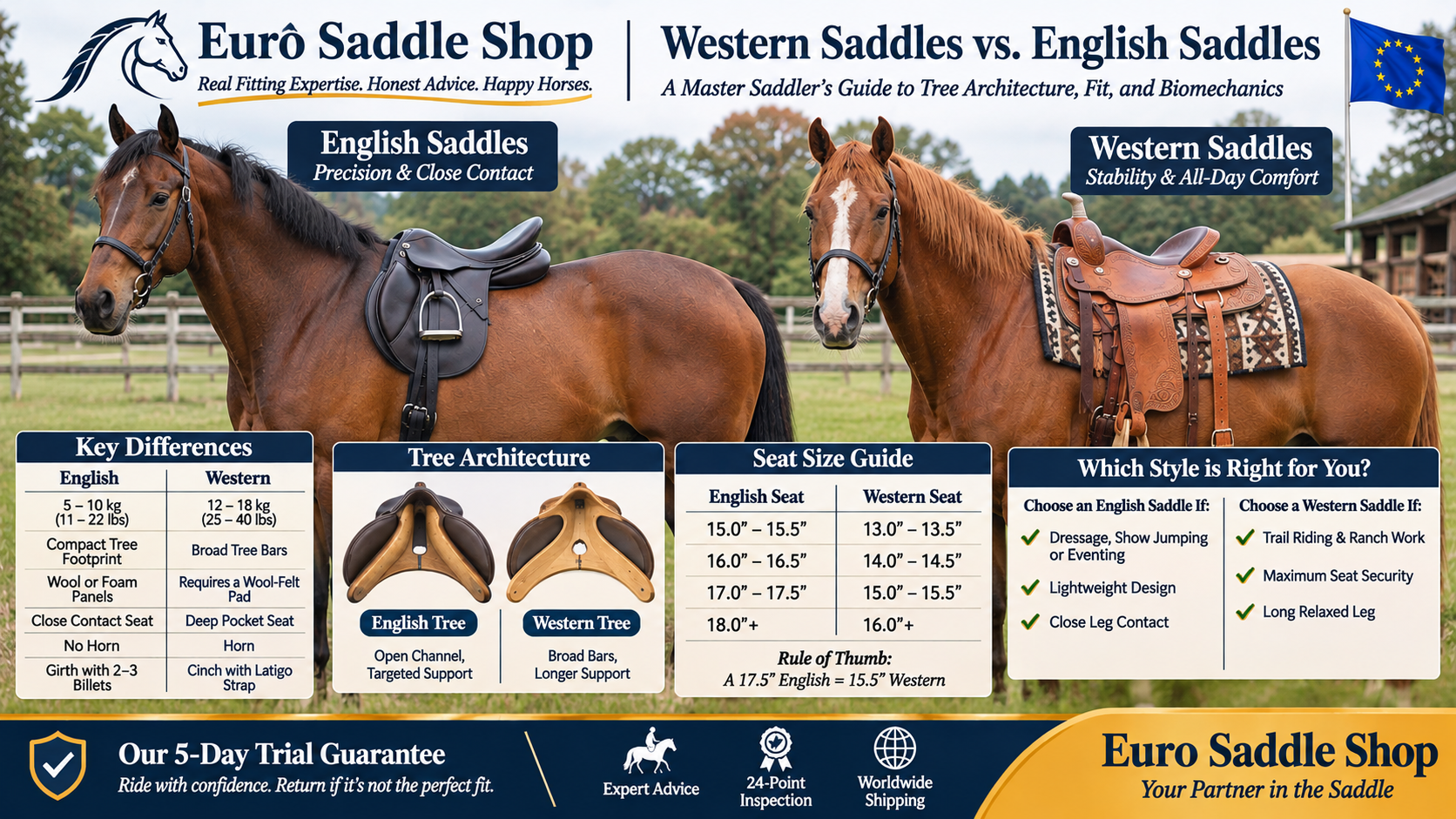
| Feature | English Saddles | Western Saddles |
| Average Weight | 5 kg – 10 kg (11 – 22 lbs) | 12 kg – 18 kg (25 – 40 lbs) |
| Tree Footprint | Compact, targeted weight-bearing footprint | Broad tree bars distributing weight across the ribcage |
| Padding System | Integrated wool-flocked or high-density foam panels | Requires a thick, shock-absorbing wool-felt pad or blanket |
| Rider Contact | Close-contact feel with minimal leather between leg and horse | Deep, pocketed seat with high pommel swell and steep cantle |
| Front Arch | Open arch or cutback pommel clearance; no horn | Built with a solid horn for roping or securing gear |
| Girthing System | Girth attaches directly to 2 or 3 leather billets | Cinch secures using a latigo strap and rigging dee rings |
1. Tree Architecture & Muscle Contact
1. Tree Architecture & Muscle Contact
The rigid frame beneath the leather determines how your body weight hits your horse’s back muscles (longissimus dorsi):
The English Tree
English trees feature a central gullet channel (ideally 3 to 5 fingers wide) bordered by padded panels stuffed with natural wool or high-density foam. The weight-bearing footprint sits strictly behind the scapula and terminates forward of the 18th thoracic vertebra (T18) to protect the sensitive lumbar region.
The Western Tree
Western trees use wide wooden or fiberglass-wrapped bars that sit flatter and extend farther down the ribcage. Because these bars lack soft, integrated leather panels, a dense wool-felt Western pad is essential to cushion the horse’s back and absorb impact.
⚠️ Saddler’s Bench Warning: A common mistake when transitioning a horse to Western tack is ignoring total back length. Short-backed horses—such as compact cobs, PREs, Lusitanos, Arabians, or stocky Quarter Horses—can easily suffer lumbar bruising if long, square Western skirts extend past the T18 vertebra. Always look for rounded or short-skirted Western trees on compact horses.
2. Seat Sizing: Converting English to Western
One of the most confusing hurdles for riders crossing over between disciplines is getting the seat size right. Western seats measure roughly 2 inches smaller than English seats because the steep cantle and front swell create a much snugger seat pocket:
| Rider Build & Frame | English Seat Size | Western Seat Size |
| Youth / Petite Adult | 15.0″ – 15.5″ | 13.0″ – 13.5″ |
| Small Adult | 16.0″ – 16.5″ | 14.0″ – 14.5″ |
| Medium Adult | 17.0″ – 17.5″ | 15.0″ – 15.5″ |
| Large / Tall Adult | 18.0″+ | 16.0″+ |
Rule of thumb: If you ride comfortably in a 17.5″ English saddle, start your search around a 15.5″ Western saddle. Regardless of style, you should always be able to place roughly 4 finger-widths between your thigh and the front pommel arch or swell.
3. Rider Posture & Postural Biomechanics
Your balance and leg position change radically depending on the saddle seat profile:
-
The English Alignment: Lower cantles and narrower twists (the section of the tree between your thighs) encourage a tall, classical ear-shoulder-hip-heel alignment. This makes posting the trot effortless and allows you to shorten your stirrups for jumping or lengthen them for flatwork.
-
The Western Pocket: A high cantle and thick pommel swell create a deep pocket that supports a relaxed seat with longer stirrups. This architecture offers passive security over rough terrain, keeping you centered during sudden movements or downhill slopes.
Which Style Suits Your Team Best?
Choose an English Saddle If:
-
You school in dressage, show jumping, eventing, or hunter classes.
-
You prefer a lightweight saddle that is easy to hoist, tack up, and carry around the barn.
-
Your horse has high, prominent withers or asymmetric muscle hollows that require custom wool-flocking adjustments.
-
You rely on subtle leg and seat contact for lateral movements.
Choose a Western (or European Stock) Saddle If:
-
You spend hours out on trail rides, hacking out, or working cattle.
-
You want maximum seat security over steep, unpredictable, or rocky terrain.
-
You prefer neck-reining and riding with a long, relaxed leg.
-
You ride broad, flat-backed breeds that fit broad tree bars well.
Test Fit in Your Own Barn: The Euro Saddle Shop 5-Day Trial
No matter how well a saddle checks out on paper, the true test happens when you put your foot in the stirrup and ask your horse to move.
Every saddle selected from Euro Saddle Shop ships straight from our central Netherlands workshop hub with our 5-day in-barn trial guarantee:
-
Bench Checked: Every tree flex, billet seam, and panel contour is verified by our workshop team before packing.
-
5 Full Trial Days: Ride in your own arena, take a lesson, and have your local independent fitter inspect the setup while it is on your horse’s back.
-
Total Freedom of Movement: Confirm your horse steps through every gait with relaxed shoulders and a swing in their back before committing.
Need Guidance Finding Your Next Saddle?
If you are unsure whether your horse requires a hoop tree, an upswept panel, or a broad-bar footprint, our saddlery team is here to evaluate your flexi-curve tracings, photos, and riding goals.
-
Email our fitting bench: sales@eurosaddle.eu
-
General inquiries: sales@eurosaddle.eu
-
Workshop Hub:
Reiterpark 14, Hallenbereich B
48231 Warendorf
Germany